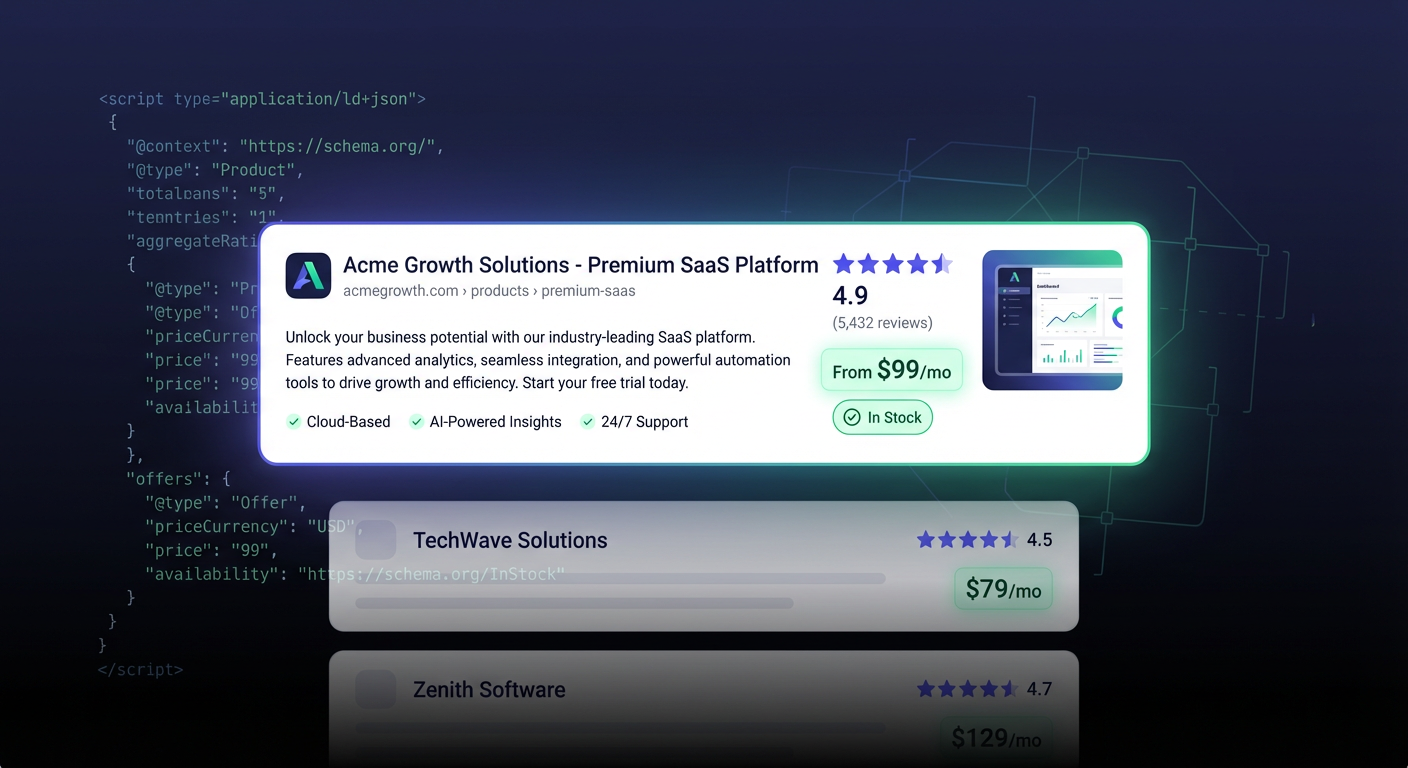
Meta Descriptions That Convert: A Shopify Guide
Write meta descriptions that increase click-through rates and drive more traffic. Proven formulas, templates, and examples for Shopify stores.
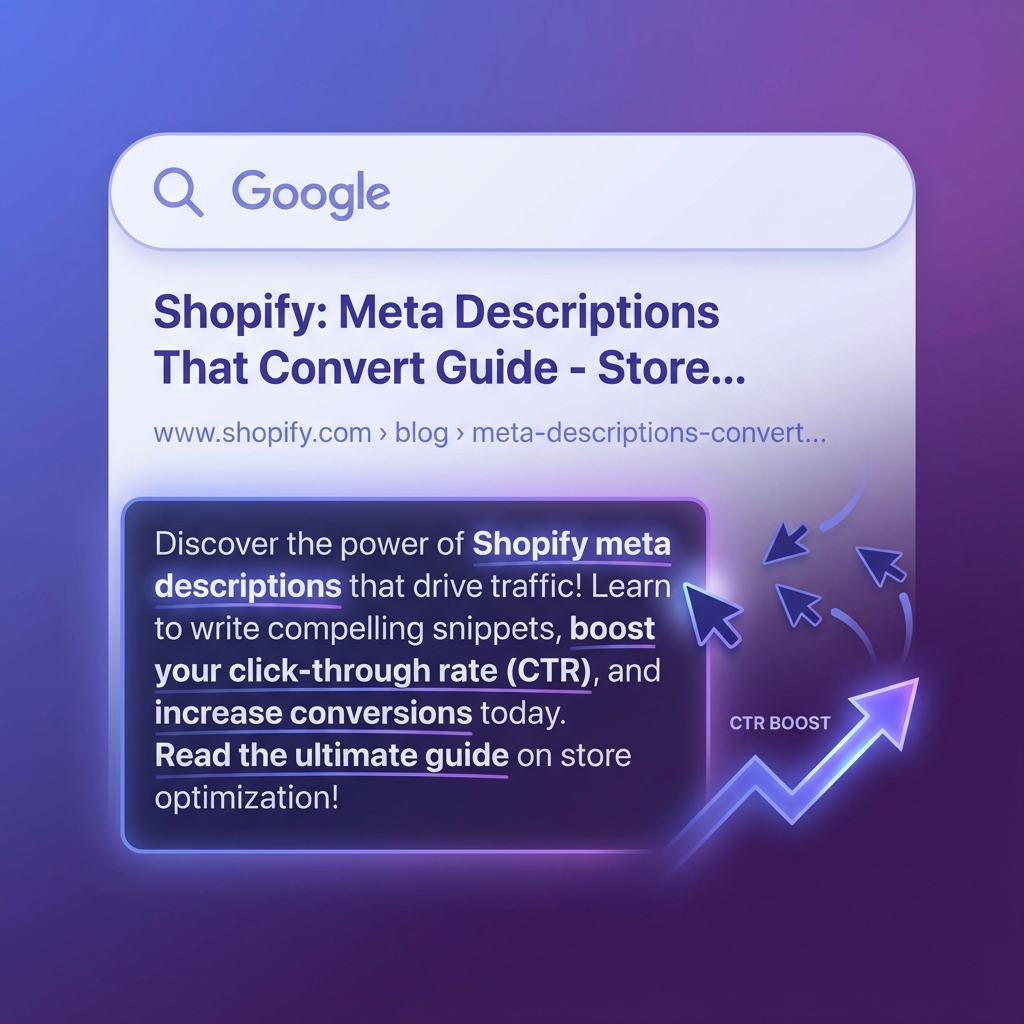
Meta descriptions are your store’s sales pitch in search results. They’re the 155 characters that convince someone to click your link instead of a competitor’s. Most Shopify merchants either ignore them entirely or write generic descriptions that fail to stand out.
This guide shows you how to write meta descriptions that actually drive clicks and conversions.
What Is a Meta Description?
A meta description is an HTML snippet that summarizes a page’s content. It appears below the title in search engine results:
Your Page Title - Brand Name
https://yourstore.com/page-url
This is where your meta description appears. It's the gray text that
gives searchers a preview of what they'll find if they click your link.
While Google says meta descriptions don’t directly affect rankings, they massively impact click-through rate (CTR) - and CTR does influence rankings.
Why Meta Descriptions Matter for E-commerce
Impact on Click-Through Rate
Studies consistently show that optimized meta descriptions can increase CTR by 5-10%. On a product getting 1,000 impressions per month, that’s 50-100 additional visitors - for free.
The Multiplier Effect
Better CTR → More clicks → More sales → Google notices the engagement → Better rankings → Even more clicks
It’s a virtuous cycle that starts with compelling descriptions.
Beating Competitors
In a crowded search result, your meta description is often the deciding factor. When five stores sell the same product, the best description wins the click.
The Anatomy of a High-Converting Meta Description
The perfect meta description includes:
- Hook: Grab attention in the first few words
- Value proposition: What makes your offer compelling
- Specifics: Numbers, features, or proof points
- Call to action: Tell them what to do next
Length Guidelines
| Platform | Optimal Length | Maximum Before Truncation |
|---|---|---|
| Desktop | 150-155 characters | ~160 characters |
| Mobile | 120-130 characters | ~130 characters |
Recommendation: Write 150-155 characters. Front-load the most important information so it’s visible even if truncated on mobile.
8 Proven Meta Description Formulas
Formula 1: Problem-Solution
Best for: Products that solve specific problems
Tired of [problem]? Our [product] [solution/benefit]. [Proof point]. Shop now + free shipping.Example: “Tired of tangled earbuds? Our magnetic wireless earbuds stay organized and charged for 40hrs. 50,000+ happy customers. Shop now with free shipping.”
Formula 2: Feature-Benefit-Action
Best for: Technical products, electronics
[Key feature] that [benefit]. [Secondary feature]. [Action] + [incentive].Example: “4K resolution that brings movies to life. Smart TV with built-in streaming apps. Shop now and get free wall mounting.”
Formula 3: Social Proof Lead
Best for: Popular products, established brands
[Social proof]. [Product description]. [Unique value]. [Action].Example: “Rated 4.9★ by 2,000+ customers. Premium yoga mat with alignment guides. Eco-friendly and non-slip. Free returns within 60 days.”
Formula 4: Urgency/Scarcity
Best for: Sales, limited editions, seasonal products
[Urgency element]. [Product] [benefit]. [Time-limited offer]. [Action].Example: “Final hours: 40% off all winter coats. Premium down insulation for -20°F warmth. Sale ends tonight. Shop the collection now.”
Formula 5: Question Hook
Best for: Educational content, problem-aware audiences
[Question]? [Product] [answer/solution]. [Proof/feature]. [Action].Example: “Looking for the perfect gift? Our curated gift boxes are handpicked and beautifully wrapped. 100+ 5-star reviews. Order by Friday for guaranteed delivery.”
Formula 6: Comparison/Alternative
Best for: Products competing with well-known alternatives
[Better alternative] to [competitor/category]. [Key differentiator]. [Action].Example: “The comfortable alternative to formal dress shoes. Italian leather loafers with sneaker-like cushioning. Shop men’s collection. Free exchanges.”
Formula 7: Story Hook
Best for: Artisan products, brand-focused stores
[Origin/story element]. [Product type]. [Quality marker]. [Action].Example: “Handcrafted in small batches by Portland artisans. Organic soy candles that burn 60+ hours. Discover our signature scents today.”
Formula 8: Direct Value Proposition
Best for: Clear, competitive offers
[Product] + [key benefit]. [Price point/value]. [Guarantee/incentive].Example: “Premium cotton t-shirts that last. $29 for a 3-pack with lifetime warranty. 30-day money-back guarantee. Shop bestsellers now.”
Meta Description Examples by Page Type
Homepage
Focus on brand value proposition and breadth of offerings:
Bad: “Welcome to our store. We sell products online. Shop now.”
Good: “Premium kitchenware for home chefs. Shop chef-grade knives, cookware & gadgets with free shipping on orders over $75. Trusted by 50,000+ cooks.”
Collection/Category Pages
Highlight the category value and range:
Bad: “Men’s shoes collection.”
Good: “Men’s leather dress shoes from $89. Oxford, derby & loafer styles in sizes 7-14. Handcrafted in Italy. Free returns and exchanges.”
Product Pages
Be specific to the individual product:
Bad: “Buy this product now.”
Good: “Merino wool running socks with arch support and moisture-wicking. Rated 4.8★ for marathon comfort. Buy 2 pairs, get 1 free. Ships same day.”
Blog Posts
Focus on the value of the content:
Bad: “Read our blog post about shoes.”
Good: “Learn how to break in leather shoes without blisters. 5 proven methods used by cobblers. Plus: mistakes to avoid that ruin new shoes.”
About Page
Build trust and credibility:
Bad: “About our company.”
Good: “Family-owned since 1985. Learn how our third-generation craftsmen make every piece by hand in our Vermont workshop. Our story + factory tour.”
Common Meta Description Mistakes
Mistake 1: Duplicate Descriptions
Using the same description for every product or page. Each page needs a unique description.
Fix: Use templates with variables to create unique descriptions efficiently.
Mistake 2: No Call to Action
Descriptions that describe but don’t compel action.
Bad: “This is a leather wallet made of genuine leather.”
Good: “Genuine leather bifold wallet with RFID protection. Slim design fits 12 cards. Shop now with free engraving.”
Mistake 3: Missing Value Proposition
Not explaining why someone should choose you.
Bad: “We sell running shoes. Browse our selection.”
Good: “Carbon-plated running shoes for PR-breaking speed. Free gait analysis with every purchase. 100-day test run guarantee.”
Mistake 4: Keyword Stuffing
Cramming keywords at the expense of readability.
Bad: “Best running shoes cheap running shoes buy running shoes online running shoes for men running shoes for women”
Good: “Performance running shoes from top brands. Men’s and women’s styles from $79. Free shipping + 30-day returns.”
Mistake 5: Too Short
Wasting valuable space that could persuade searchers.
Bad: “Shop shoes online.” (17 characters)
Good: “Premium running shoes with 30-day trial. Free shipping both ways. Expert fitting advice. Shop men’s & women’s styles now.” (122 characters)
Mistake 6: Ignoring Mobile Truncation
Writing descriptions that lose meaning when cut off at 120 characters.
Bad: “After extensive research and development, our team created what we believe to be the ultimate solution for those looking for…”
Good: “Ultimate productivity app for remote teams. 50% faster project completion. Free 14-day trial. Used by 10,000+ companies.”
How to Add Meta Descriptions in Shopify
For Products
- Go to Products → Select product
- Scroll to Search engine listing preview
- Click Edit website SEO
- Enter your meta description (155 characters max)
- Click Save
For Collections
- Go to Products → Collections
- Select collection
- Scroll to Search engine listing preview
- Click Edit website SEO
- Add meta description
For Pages
- Go to Online Store → Pages
- Select page
- Find Search engine listing preview at bottom
- Click Edit website SEO
For Blog Posts
- Go to Online Store → Blog posts
- Select post
- Scroll to Search engine listing preview
- Add meta description
Bulk Optimization Strategies
Strategy 1: Template-Based Generation
Create templates for each page type:
Product template:
[Product Name] - [Key Feature]. [Benefit]. [Social Proof]. Shop now + [Incentive].Fill in variables from your product data for unique descriptions at scale.
Strategy 2: AI-Assisted Writing
Tools like StoreAuditor can generate optimized meta descriptions by analyzing:
- Your product titles and descriptions
- Target keywords
- Competitor descriptions
- Character count requirements
Strategy 3: Prioritized Manual Writing
If you must write manually, prioritize:
- Homepage - First impression for brand searches
- Top 20% of products - By traffic or revenue
- Collection pages - Category-level optimization
- Blog posts with traffic - Improve existing performers
Testing and Measuring Meta Descriptions
Google Search Console Tracking
- Go to Performance → Search results
- Compare CTR changes after updating descriptions
- Look at individual page performance
A/B Testing Approach
For important pages:
- Write version A, publish for 2-4 weeks
- Track impressions and CTR
- Write version B, publish for 2-4 weeks
- Compare results, keep the winner
Key Metrics to Watch
| Metric | What It Tells You |
|---|---|
| CTR | Description effectiveness |
| Impressions | Keyword visibility |
| Position | Ranking (indirect indicator) |
| Clicks | Actual traffic generated |
Meta Description Checklist
Before publishing any page, verify:
- Description is 150-155 characters
- Includes primary keyword naturally
- Has clear value proposition
- Contains call to action
- Is unique (not duplicated)
- Front-loads important information
- Matches page content accurately
- Includes social proof if available
- Works when truncated to 120 characters
Quick Reference: Power Words for Meta Descriptions
Urgency:
- Today, Now, Limited, Final, Last chance, Hurry
Value:
- Free, Save, Discount, Exclusive, Best price, Value
Trust:
- Guaranteed, Certified, Official, Authentic, Proven
Action:
- Shop, Discover, Get, Try, Start, Explore, Learn
Social proof:
- Rated, Trusted, Loved by, ★, #1, Award-winning
Specificity:
- Numbers (50,000+, 4.9★, 30-day, 100%)
- Time (Same-day, 24hr, Instant)
- Money ($X off, X% savings)
Automate Meta Description Optimization
Writing unique meta descriptions for hundreds of products is time-consuming. StoreAuditor helps by:
- Identifying pages with missing or weak meta descriptions
- Generating AI-powered suggestions based on your content
- Scoring descriptions for SEO effectiveness
- Tracking which descriptions perform best
The goal is compelling, unique descriptions for every page - without the manual effort.
Key Takeaways
- Every page needs a unique meta description: Don’t leave it to chance
- 150-155 characters is optimal: Front-load the important stuff
- Use proven formulas: Problem-solution, social proof, urgency
- Include a call to action: Tell them what to do
- Add specifics: Numbers and proof points build credibility
- Test and measure: CTR improvements are measurable
- Prioritize high-traffic pages: Focus effort where it matters most
Your meta description is often the difference between a click and a scroll-by. Every character is an opportunity to win a new customer.
Want to audit your store’s meta descriptions? Try StoreAuditor free and get instant SEO scores for every page.